


Many community colleges spend a significant amount of their marketing budget each year on media monitoring services like Cision or Meltwater, and for several years our institution was no exception. But over time the weaknesses of said systems became obvious.

For example, media monitoring software
+ Is expensive, costing thousands of dollars per year.
+ Regularly misses major media mentions, especially in local print newspapers and magazines.
+ Regularly picks up mentions that aren’t relevant, often about completely different organizations.
+ Often doesn’t catch a fraction of mentions on social media, where the bulk of our audiences get their news and information.
An issue of major concern is that no media monitoring service seems to adequately track social media, which is where the vast majority of our audiences communicate and get their news. A media monitoring service would often catch a mention buried in a random obituary, for example, but miss a major post about our college in a local Facebook group with 30,000 followers and tons of engagement.
Ultimately the above issues led to us having to manually track mentions to a certain extent anyway, which only led to us finding more mentions missed by the software.
So a few years ago we instituted a new media tracking process we dubbed “mentions that matter.”
Mentions that matter
Most organizations have multiple reasons for monitoring media mentions or their organization. They want to track public sentiment generally or about a given topic or initiative. They want to catch positive mentions so they can amplify them on their owned channels. Or they want to catch negative mentions so they can head them off or mitigate potential reputational threats.
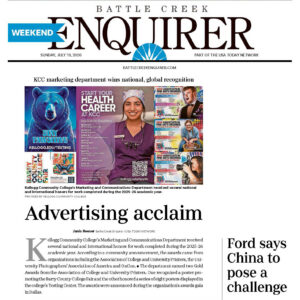
A lot of organizations also like to track mentions so they can provide upper leadership with an advertising equivalency, aka how much money they would’ve had to spend on ads to get equal coverage they earned freely.
But the truth is, not all media mentions matter.
Does a mention of your organization’s name buried in a 1,000-word article about an unrelated topic really matter to your audiences? How about the half dozen out-of-state mentions in the regional sports roundups saying your sports team lost to whatever team was local in that region the previous weekend? What about a mention 10 pages into Google search results?
We realized pretty quickly that if we in the marketing department have to search to find a mention intentionally, if we have to actively take time to look for it, then it’s probably not a mention that the average audience member is going to stumble on and attend to incidentally. So does a mention like that matter? Probably not.
Our new system, which we’ve used to report to upper administration for three years, tracks only major media mentions. We consider mentions “major” if
1. They include our college’s name in the headline.
2. The story is specifically about our college or topically involves the college in some undeniably meaningful way.
3. They are unusually prominent, like on the front page of a newspaper.
We also report mentions if they have some public relations/lobbying value for someone in upper administration, like the president or head of our foundation.
What we don’t report is every blog-spam mention, every sports score mention, every obituary mention (unless relevant for the foundation), etc.—though we generally do see those and monitor them less formally for reputation management.

The process
So how do we monitor said mentions? We do everything manually, running Google searches (again, only to a certain depth) and consistently keeping our ears to the ground on social media. We also have a staff person who scans print. At the beginning of each month, I compile all the major mentions into an email and send it to select upper administration with background/explainer copy to provide context for each mention.
It’s simple and bare bones, and it takes way less time than one might think. The bulk of the time is just preparing the emailed report, which I had to do when using the monitoring software, anyway.
It’s also free.
But what about tracking advertising equivalency?
That’s probably a topic for another day; but in our experience, the relevant numbers given by the media monitoring platforms are wildly wrong. One article aggregated to Yahoo would get reported as getting millions of views, translating to thousands of dollars in ad equivalency, for example. Meanwhile, those of us who’ve worked in media know that that Yahoo article, which was aggregated from whatever Gannett news source, probably got only a couple dozen views, if that. So we’ve always taken those numbers with a grain of salt, anyway.
One caveat for those considering adopting our process: Our college operates in a smaller area than a lot of institutions: Our largest county in our mostly rural, three-county district has a population of less than 150,000. Plus our region has become a drier and drier media desert over the years. Our major media outlets consist of a continually shrinking daily newspaper, a robust weekly shopper and a local TV news station that rarely covers community college news.
So would this process work for an institution in a larger area with more active media? Every institution is different, but I think it’d work. Especially for institutions with small (and shrinking) budgets, defining and manually tracking mentions that matter only could be an efficient move that saves money and provides your institution with more relevant results—results that actually matter.
A version of this post was shared to NCMPR’s listserv in response to a discussion on media monitoring. Access to NCMPR’s listserv is a benefit of membership.
Simon A. Thalmann is the director of marketing at Kellogg Community College in Michigan and a 15-year member of NCMPR. The college has won more than 100 Medallion awards and nearly three dozen Paragon awards during Thalmann’s tenure in the department, highlighted by a 2020 Best in Show Paragon for “Blaze Goes to College,” an original children’s book that Thalmann created and authored.

STAY CONNECTED